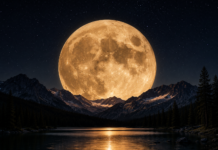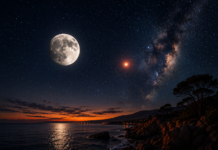
A Blood Moon is not a sign, an omen, or a mystery of fate — it is one of the most precise and elegant demonstrations of celestial mechanics in our sky.
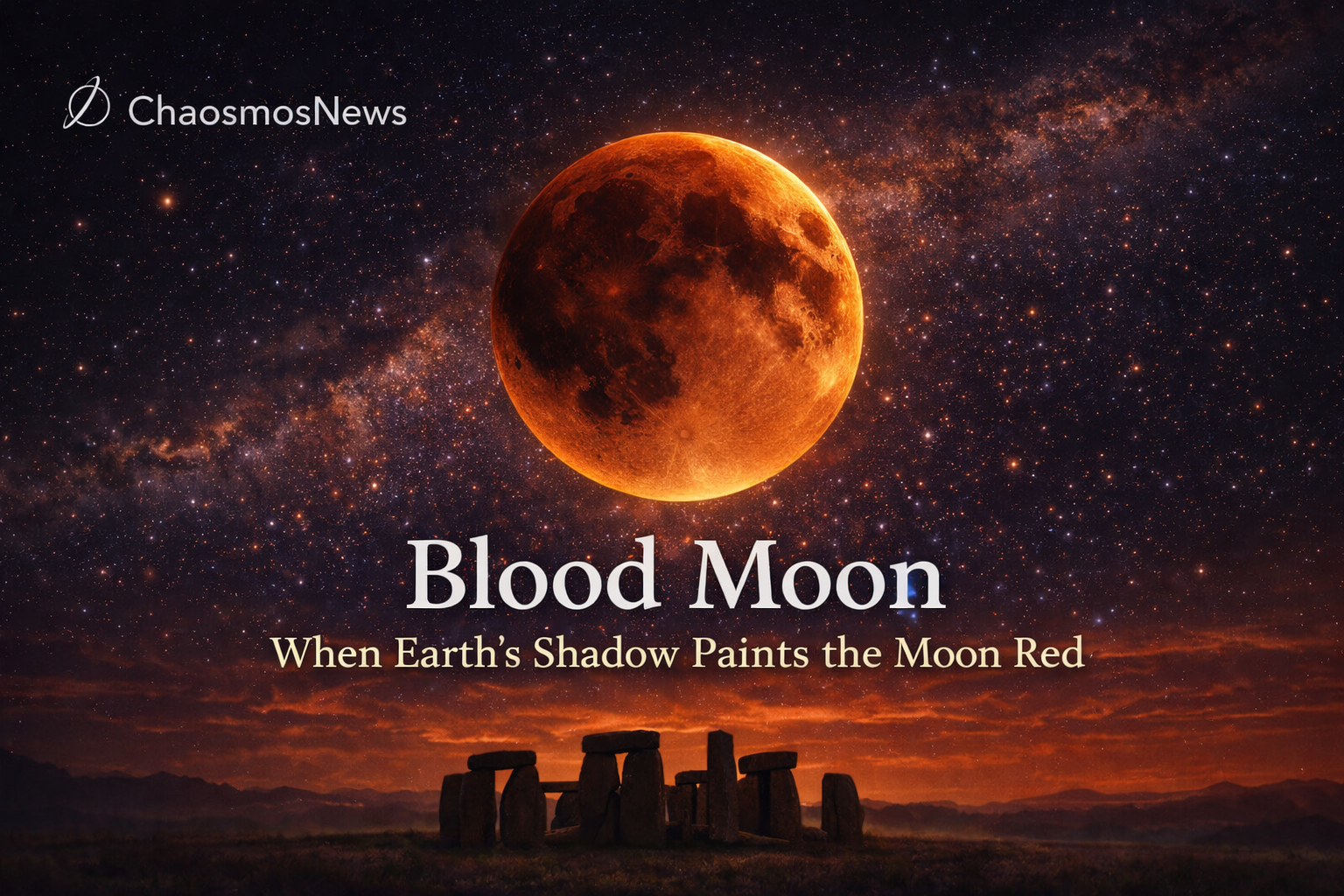
During a total lunar eclipse, the Moon passes entirely into Earth’s shadow. Instead of disappearing, it transforms. The familiar silvery surface slowly darkens, then emerges in deep shades of copper, amber, and crimson. This striking transformation is what we call a Blood Moon.
But the color does not come from the Moon itself.
? How the Moon Turns Red
As sunlight reaches Earth, our atmosphere acts like a giant lens. Shorter blue wavelengths scatter away into space — the same process that makes our daytime sky blue. Longer red wavelengths, however, bend around Earth and continue their journey.
When the Moon sits inside Earth’s shadow, this filtered light is gently projected onto its surface. The result is a Moon illuminated not by direct sunlight, but by every sunrise and sunset on Earth at once.
In that moment, the Moon reflects the collective atmosphere of our planet.
? A Silent Cosmic Alignment
A Blood Moon can only occur when the Sun, Earth, and Moon align with remarkable precision. The Moon must be full. Its orbit must intersect Earth’s shadow perfectly. Even slight variations in distance, angle, or atmospheric conditions can alter the Moon’s color — from bright orange to deep, smoky red.
No two Blood Moons look exactly the same.
Some appear faint and ghostlike. Others glow intensely, as if lit from within. Volcanic dust, wildfires, and even global weather patterns can subtly influence the shade we see in the sky.
? Why Blood Moons Captivate Us
Unlike solar eclipses, lunar eclipses unfold slowly. There is no sudden darkness, no need for special equipment. The transformation happens gradually, quietly, allowing time to observe, reflect, and feel the motion of the cosmos.
For ancient civilizations, Blood Moons inspired myths and rituals. For modern observers, they offer something equally powerful — a direct, visible reminder that Earth is not isolated, but part of a vast, moving system governed by light, shadow, and gravity.
This is astronomy made visible to the naked eye.
? A Reminder of Cosmic Time
A Blood Moon does not rush. It lingers.
For a brief window, the Moon remains fully immersed in Earth’s shadow, suspended in red light. Then, just as slowly, it brightens again and returns to its familiar glow — leaving behind only memory and awe.
These events remind us that even in a fast-moving world, the universe operates on its own rhythm — steady, precise, and indifferent to human urgency.
✨ More Than a Moon
A Blood Moon is not rare because it is unpredictable. It is rare because it requires perfection.
Perfect alignment.
Perfect timing.
Perfect shadow.
And when it happens, the sky quietly reminds us where we are — standing on a moving planet, watching our own shadow reach across space.
ChaosmosNews
Exploring the silent architecture of the universe.