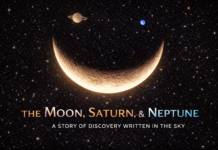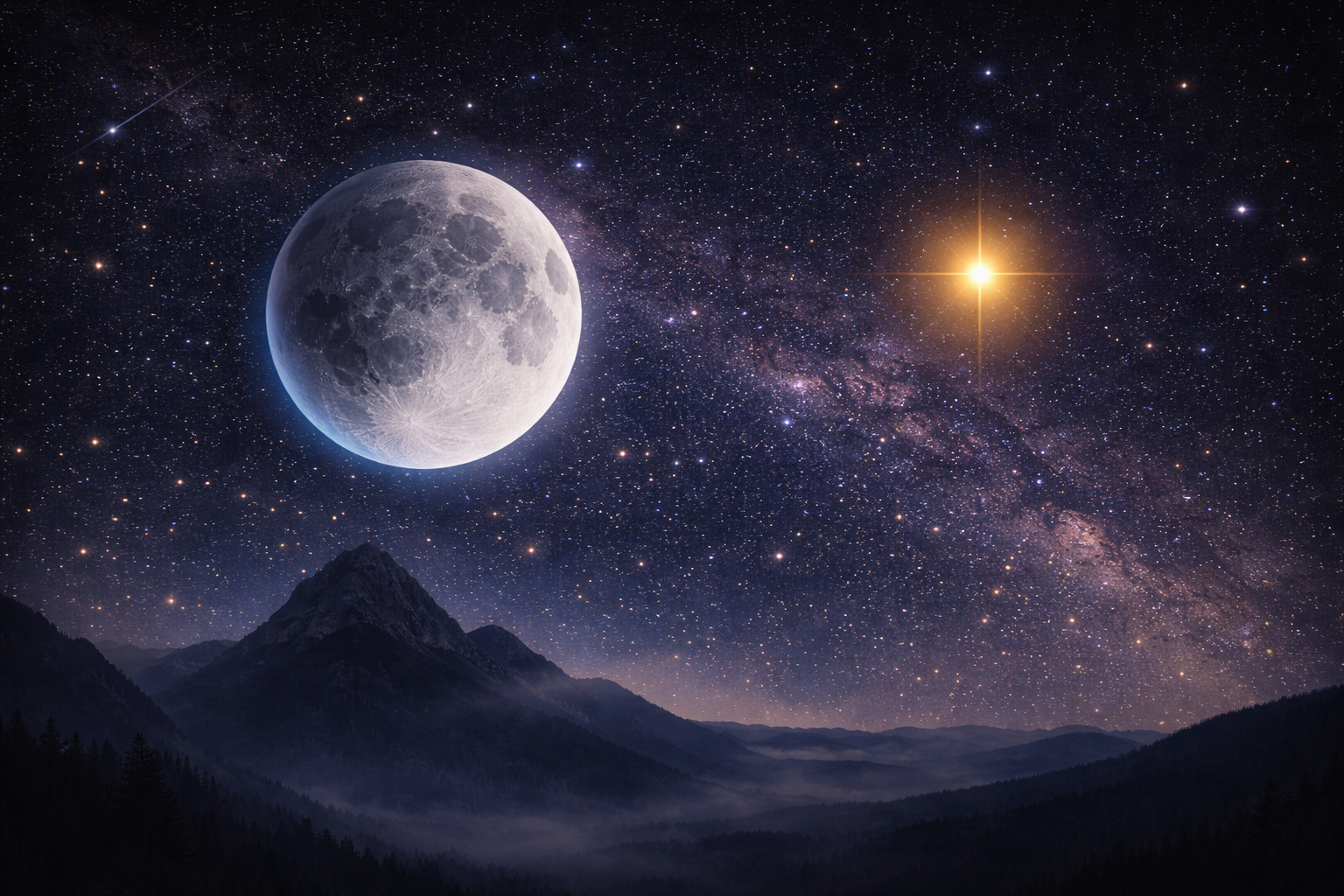
Tonight, skywatchers around the world will be treated to a beautiful celestial encounter as the Moon appears close to Jupiter — the largest planet in our solar system.
This striking alignment brings together two of the brightest objects visible in the night sky, creating an easy-to-spot and visually captivating event for both casual observers and astronomy enthusiasts.
✨ A Bright and Easy-to-See Sky Event
Unlike many astronomical events that require telescopes or dark-sky locations, this conjunction is visible with the naked eye.
Shortly after sunset, look toward the western sky. The Moon will shine prominently, while Jupiter appears nearby as a bright, steady golden point of light.
What makes this event special is not just the proximity — but the contrast:
- The Moon: large, detailed, and softly illuminated
- Jupiter: small, intense, and glowing with a warm golden hue
Together, they create a natural “cosmic pairing” that stands out even in light-polluted areas.
? Why Jupiter Shines So Bright
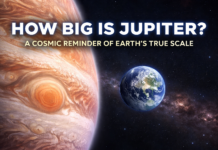
Jupiter is the largest planet in our solar system, more than twice as massive as all the other planets combined. Its brightness comes from two main factors:
- Its enormous size
- Its highly reflective cloud tops
Even though it lies hundreds of millions of kilometers away, Jupiter often becomes the second-brightest object in the night sky after the Moon.
Unlike stars, Jupiter does not twinkle. Instead, it shines steadily — a key clue that you’re looking at a planet.
? A Deeper Look with Binoculars
For those with binoculars or a small telescope, this event becomes even more rewarding.
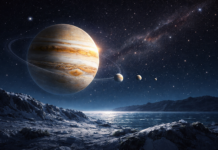
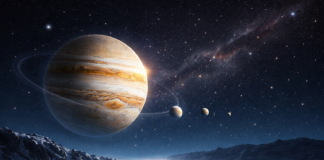
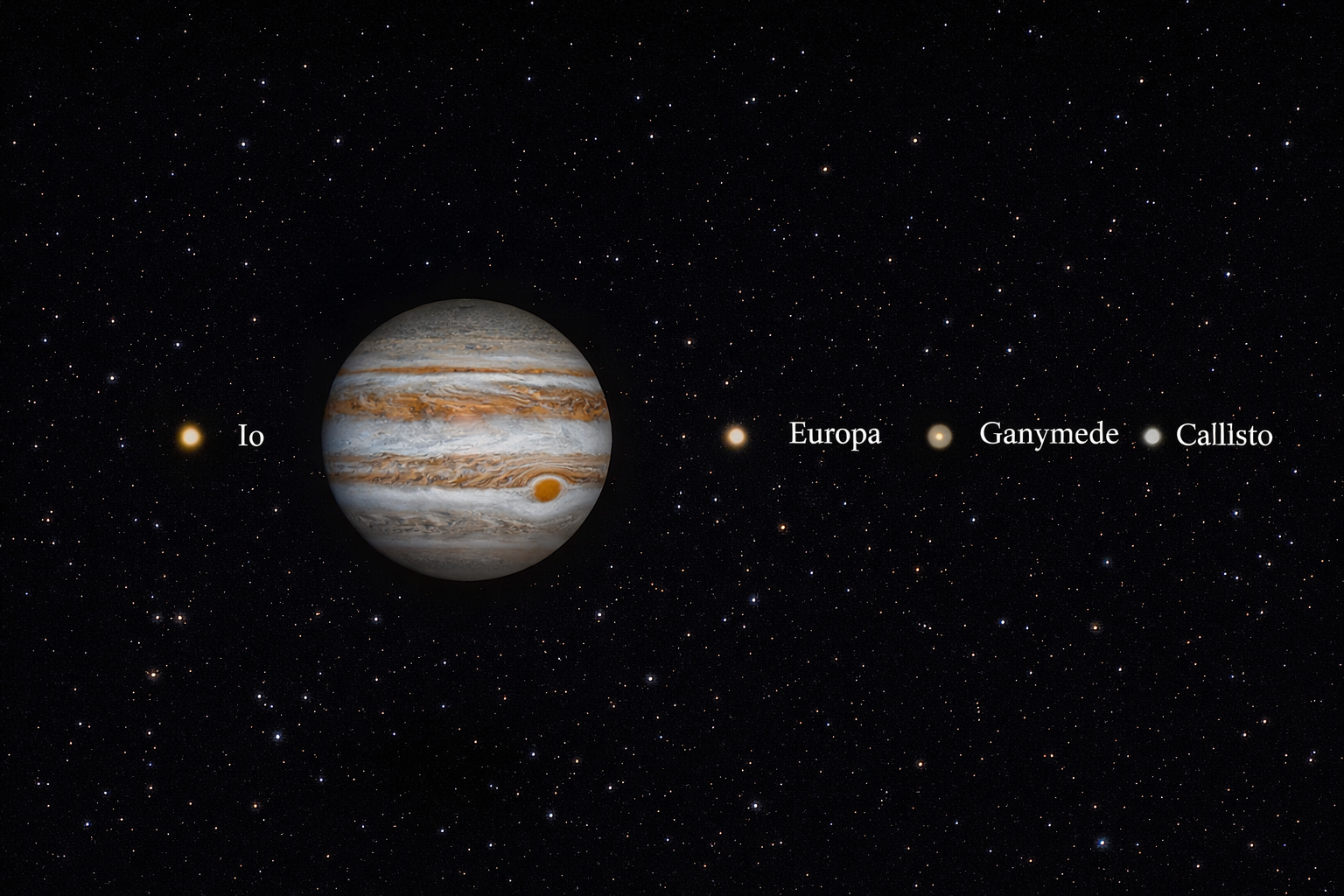
You may be able to spot Jupiter’s four largest moons, known as the Galilean moons:
- Io
- Europa
- Ganymede
- Callisto
These tiny points of light appear lined up near the planet and shift positions night by night — a miniature solar system in motion.
? The Moon’s Role in the Encounter
The Moon acts as a visual guide in the sky, helping observers easily locate Jupiter.
Depending on its phase, the Moon may appear:
- Half-lit
- Waxing or waning
- Bright enough to illuminate the surrounding sky
Its presence enhances the scene, adding scale and depth to the encounter.
⏰ When and Where to Watch
- Time: Shortly after sunset
- Direction: Western sky
- Visibility: Global (best with clear skies)
No special equipment is required — just step outside and look up.
? A Reminder of a Dynamic Sky
Events like this highlight how active and ever-changing our night sky truly is.
The Moon moves quickly across the sky, passing near planets and stars throughout the month. Jupiter, on the other hand, follows a slower path along the ecliptic — the same path traced by the Sun and planets.
When these paths intersect from our point of view on Earth, we witness moments like this — brief, beautiful alignments that connect us to the larger mechanics of the solar system.
? Final Thought
Tonight’s Moon–Jupiter conjunction is more than just a visual treat — it’s a reminder that even without advanced equipment, the universe is accessible to everyone.
All it takes is a clear sky… and the decision to look up.
? Look up tonight.
You won’t want to miss this one.