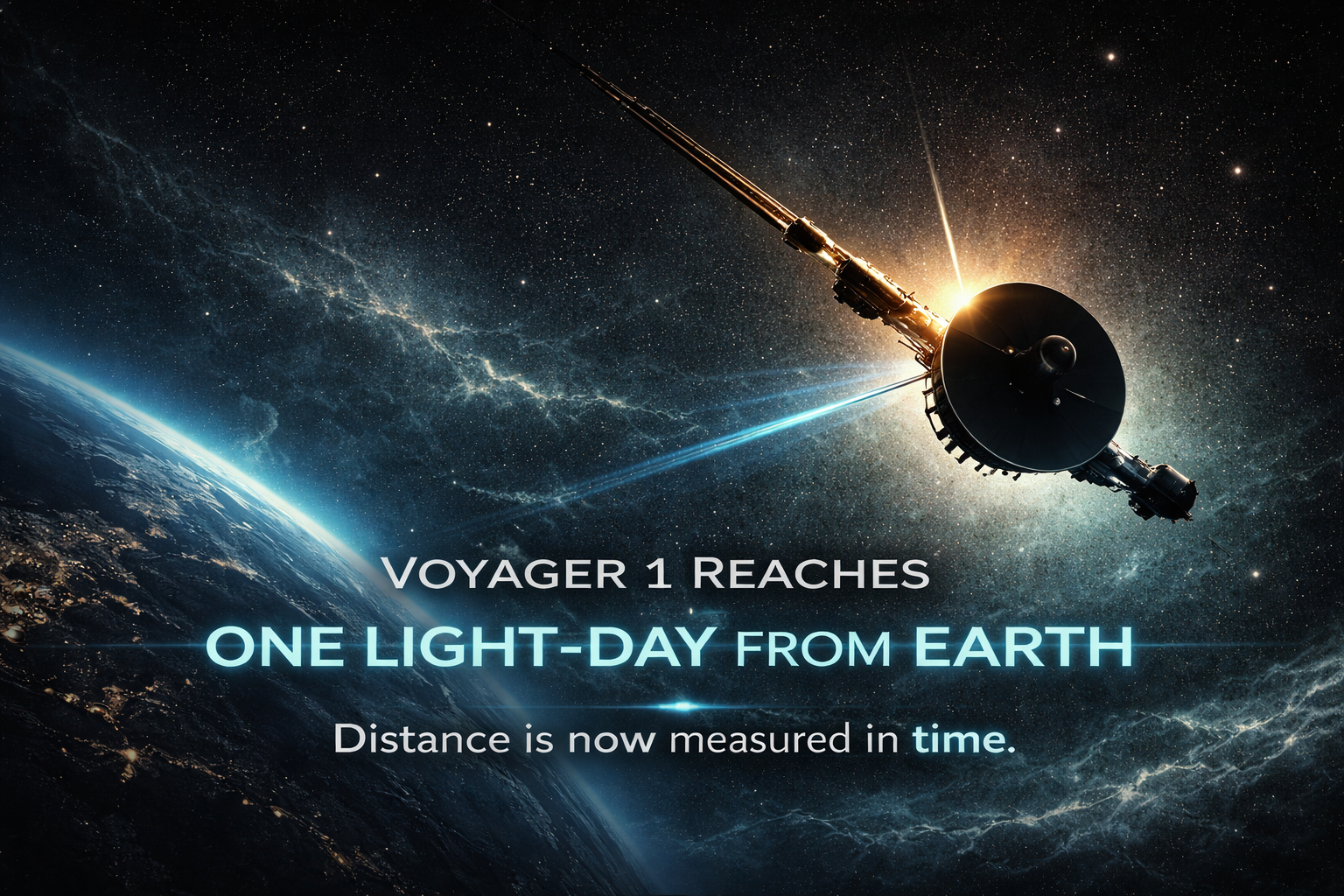
Humanity’s farthest spacecraft has just crossed a new threshold — not measured in distance, but in time.
Nearly half a century after its launch, NASA’s legendary spacecraft Voyager 1 has reached a remarkable milestone: it is now approximately one light-day away from Earth.
This means that any signal sent from our planet takes a full 24 hours to reach the spacecraft — a powerful reminder of just how vast space truly is.
? A Journey That Began in 1977
Launched by NASA on September 5, 1977, Voyager 1 was originally designed to explore the outer planets of our solar system.
During its early mission, the spacecraft delivered groundbreaking discoveries:
- Detailed images of Jupiter and Saturn
- Insights into planetary atmospheres and magnetic fields
- The discovery of active volcanoes on Io
But Voyager 1 didn’t stop there.
After completing its primary mission, it continued its journey outward — eventually becoming the first human-made object to enter interstellar space.
?️ What Does “One Light-Day” Mean?
A “light-day” is the distance that light travels in 24 hours — about 25.9 billion kilometers (16.1 billion miles).
At this distance:
- Communication is no longer instant
- Commands take a full day to arrive
- Responses take another day to return
In other words, a simple exchange between Earth and Voyager 1 now takes two full days.
This milestone marks a profound shift:
Space is no longer just measured in kilometers…
but in time.
? Drifting Through Interstellar Space
Voyager 1 is currently traveling through interstellar space — the region beyond the influence of our Sun’s solar wind.
Out there:
- There is no sunlight as we know it
- The spacecraft is surrounded by particles from distant stars
- Temperatures drop to near absolute zero
And yet, Voyager 1 continues to send data back to Earth using its onboard instruments.
? A Fading but Persistent Signal
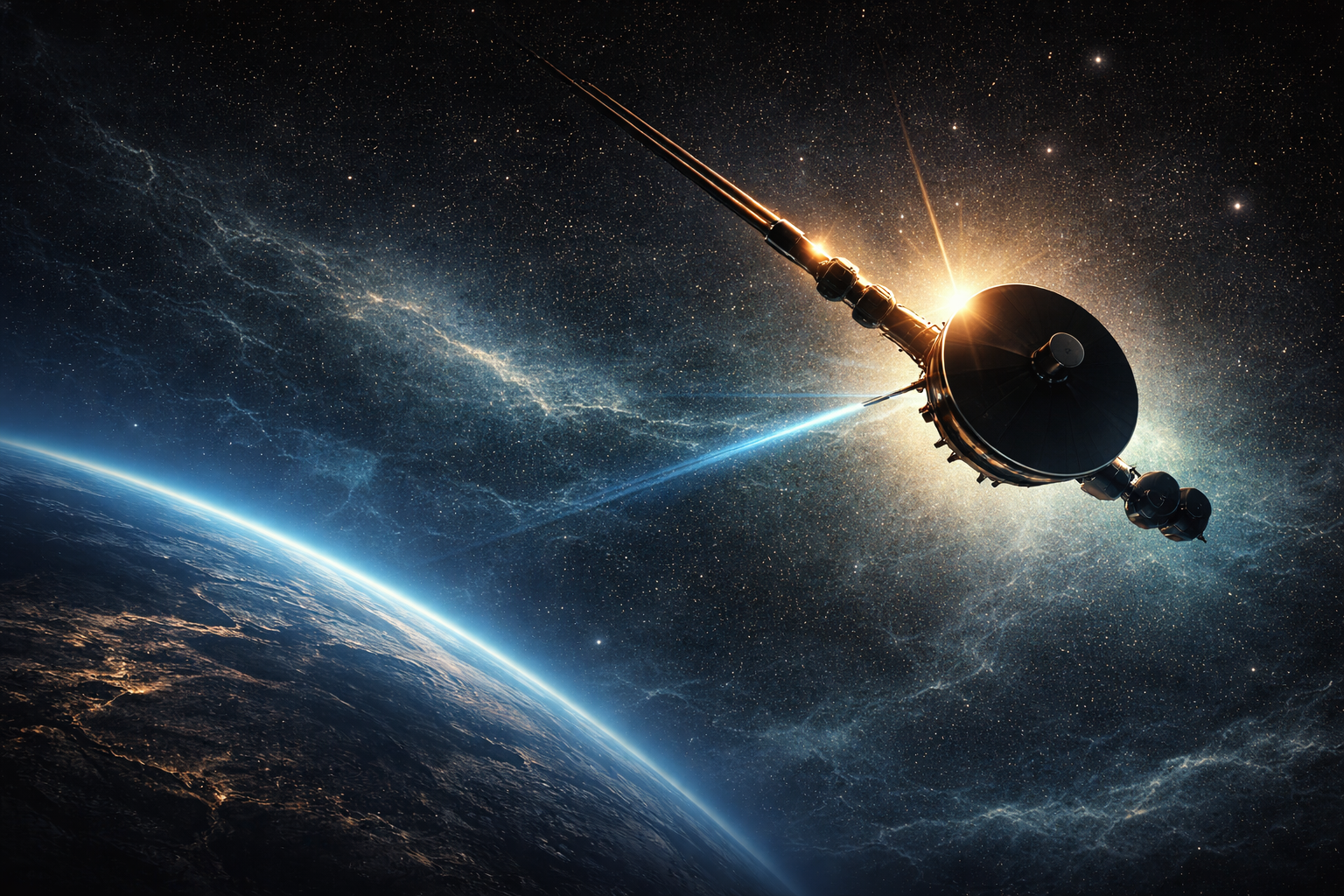
Despite its incredible distance, Voyager 1 is still communicating with Earth via NASA’s Deep Space Network.
However, this connection is becoming increasingly fragile:
- Signal strength weakens over distance
- Power is slowly decreasing
- Some instruments have already been shut down
Scientists estimate that Voyager 1 may continue transmitting data until the early 2030s.
? Humanity’s Message to the Cosmos
Attached to Voyager 1 is one of humanity’s most iconic creations: the Golden Record.
This record contains:
- Sounds of Earth
- Music from different cultures
- Greetings in multiple languages
- Images representing life on our planet
It is a message — not to any specific destination, but to the universe itself.
✨ A Journey Without an End
Voyager 1 will never return.
It will continue drifting through the Milky Way for millions — even billions — of years.
Long after Earth has changed…
long after humanity evolves…
Voyager will still be out there.
A silent traveler.
A cosmic time capsule.
A reminder of who we were.
? Final Thought
At one light-day away, Voyager 1 has crossed an invisible boundary — not just in space, but in how we understand distance itself.
Because out there…
Distance is no longer measured in miles.
It is measured in time.