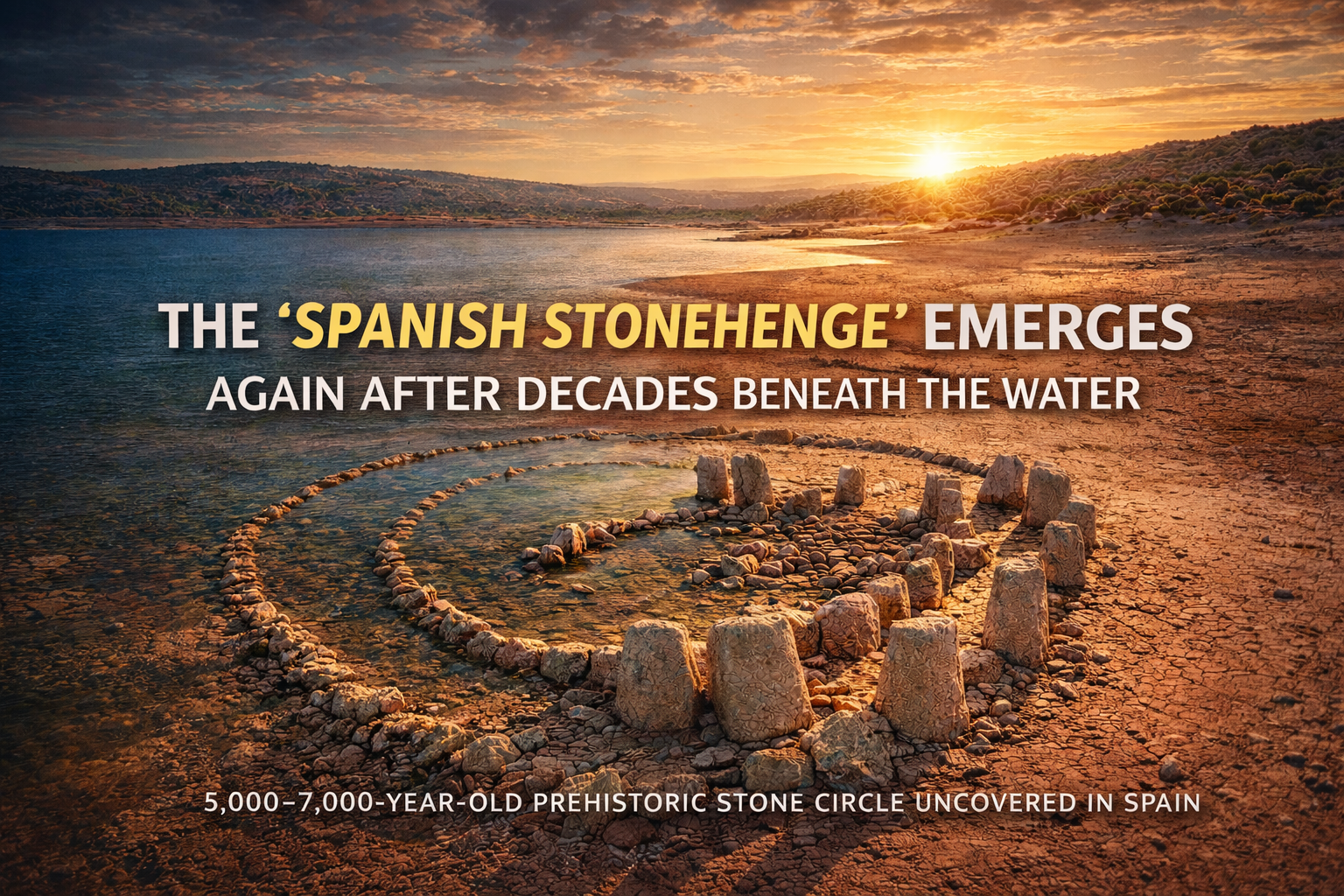
In the remote landscapes of western Spain, a remarkable prehistoric monument has once again emerged from the depths of a reservoir. Known as the Dolmen of Guadalperal, this ancient stone circle—often called the “Spanish Stonehenge”—has reappeared after extreme drought caused water levels to fall dramatically.
The site, located in the region of Extremadura, is believed to be between 5,000 and 7,000 years old, making it one of the oldest megalithic monuments on the Iberian Peninsula.
For decades, the structure remained hidden beneath the waters of the Valdecañas Reservoir, only briefly revealing itself during periods of unusually low water levels. But as severe drought continues to affect parts of southern Europe, the ancient monument has once again surfaced, offering a rare glimpse into a distant chapter of human history.
A Monument Older Than Many Famous Ancient Wonders
The Dolmen of Guadalperal dates back to the Neolithic period, when early agricultural communities began constructing large stone monuments across Europe.
While the exact purpose of the monument remains uncertain, archaeologists believe it may have served several functions, including:
• ceremonial gatherings
• burial rituals
• astronomical observations
• territorial markers for ancient communities
The structure originally consisted of a circular arrangement of large upright stones forming a chambered tomb. At its center once stood a burial chamber covered by massive capstones.
Over thousands of years, erosion and environmental changes altered the landscape, but the core of the stone circle survived remarkably well.
Lost Beneath Water in the 20th Century
The monument’s modern history took a dramatic turn in 1963, when the Franco-era government constructed the Valdecañas dam.
As the reservoir filled, entire landscapes—including the ancient stone circle—were submerged beneath the rising waters. Unlike some historical sites that were relocated before flooding, the Dolmen of Guadalperal remained in place.
For most of the year, the monument lies hidden beneath the surface of the reservoir, invisible to the outside world.
Only during periods of severe drought, when water levels drop significantly, does the ancient structure reappear.
A Rare Glimpse into Europe’s Prehistoric Past
The re-emergence of the Spanish Stonehenge offers archaeologists and historians a valuable opportunity to study the monument up close.
Researchers have identified more than 100 standing stones arranged in a circular pattern, many of which still show signs of ancient carvings and weathering patterns.
One particularly intriguing feature is a large engraved stone believed to depict a serpent-like pattern or map of a nearby river system, suggesting the monument may also have held symbolic or geographic significance.
Climate Change and the Return of Ancient Landscapes
Ironically, the monument’s reappearance is tied to a troubling environmental reality.
Across southern Europe, prolonged droughts and declining reservoir levels are exposing landscapes that have been submerged for decades.
While these conditions allow lost archaeological sites to be rediscovered, they also highlight the growing impacts of climate change on water systems and ecosystems.
The Spanish Stonehenge is just one of many ancient sites around the world being revealed as water levels continue to drop.
A Window Into Humanity’s Earliest Civilizations
Today, the re-emerged Dolmen of Guadalperal stands as a silent reminder of the people who lived thousands of years before modern civilizations took shape.
Long before the pyramids of Egypt rose from the desert or the famous stones of Stonehenge were erected in Britain, ancient communities on the Iberian Peninsula were already shaping the landscape with monumental architecture.
As the waters recede, this prehistoric stone circle once again stands under the open sky—offering a rare and powerful connection to humanity’s deep past.