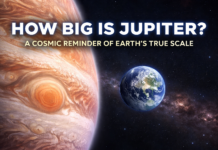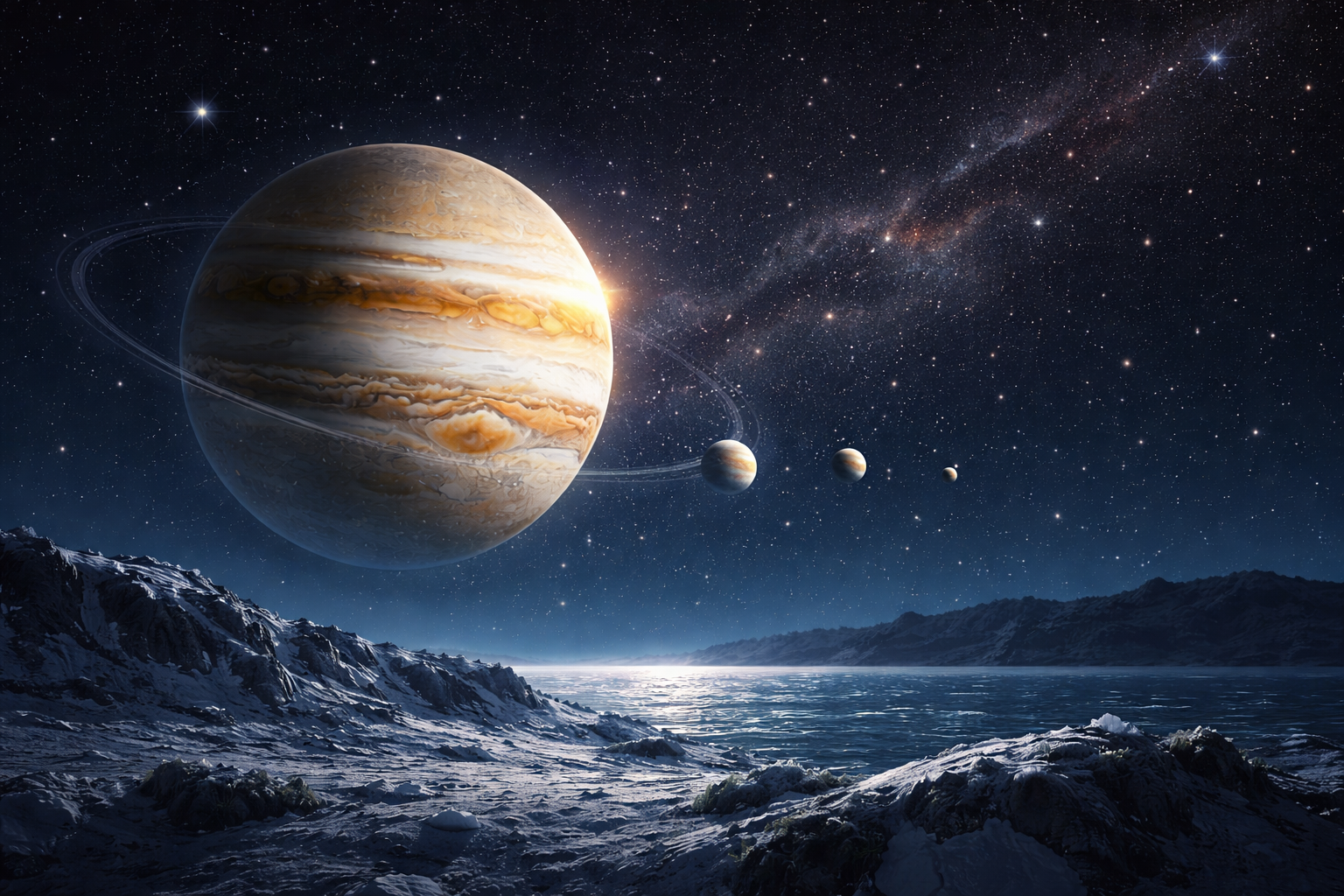
Jupiter is not just the largest planet in the Solar System.
It is a gravitational architect, a cosmic shield, and a living record of how planets are born.
More massive than all the other planets combined, Jupiter dominates its region of space with an influence that extends far beyond its visible disk. Its presence shapes orbits, redirects comets, and preserves clues about the earliest days of the Solar System.
To observe Jupiter is not merely to look at a planet — it is to witness scale, motion, and time interacting in real space.
A Planet Made of Atmosphere
Unlike Earth, Jupiter has no solid surface. What we see is an immense atmosphere composed primarily of hydrogen and helium, layered into powerful jet streams that circle the planet at astonishing speeds.
These bands — light zones and dark belts — are driven by internal heat rising from deep within Jupiter’s core. The planet emits more energy than it receives from the Sun, making it a world powered as much from within as from above.
The most famous feature within this turbulent atmosphere is the Great Red Spot — a storm larger than Earth itself, raging continuously for centuries. It is a reminder that Jupiter is not static. It is dynamic, violent, and alive with motion.
The Guardian of the Inner Solar System
Jupiter’s immense gravity plays a crucial role in shaping the Solar System’s architecture. It acts as both protector and disruptor.
-
It deflects or captures comets and asteroids that might otherwise threaten the inner planets.
-
It sculpts the asteroid belt, preventing it from forming into a planet.
-
It influences the orbital stability of Mars and beyond.
Without Jupiter, the Solar System — and possibly Earth itself — would look very different.
A System Within a System
Jupiter is often described as a “failed star,” but in truth, it is something else entirely:
a miniature solar system of its own.
Its largest moons rival planets in complexity:
-
Io is the most volcanically active body known.
-
Europa hides a global ocean beneath its icy crust.
-
Ganymede, the largest moon in the Solar System, has its own magnetic field.
-
Callisto preserves an ancient, cratered surface that records early Solar System history.
Together, these moons form a laboratory for studying geology, magnetism, and the potential for life beyond Earth.
Light, Distance, and Perspective
From Earth, Jupiter appears as a steady, brilliant point of light — bright enough to command attention even in polluted skies. Unlike stars, it does not twinkle. Its light is reflected sunlight, returning to us after traveling across hundreds of millions of kilometers.
At times when Earth and Jupiter align favorably, the planet reveals its structure with remarkable clarity. These moments are reminders that celestial mechanics are not abstract calculations — they are visible, predictable motions unfolding overhead.
Why Jupiter Matters
Jupiter teaches us scale.
It reminds us that planets can be worlds without surfaces, storms without land, oceans without water. It shows how gravity shapes history and how motion defines structure. More than any other planet, Jupiter bridges the gap between planets and stars, between formation and evolution.
To look at Jupiter is to understand that the Solar System is not quiet.
It is ordered, but alive.
And Jupiter is its dominant rhythm.
ChaosmosNews
Where celestial motion meets perspective.