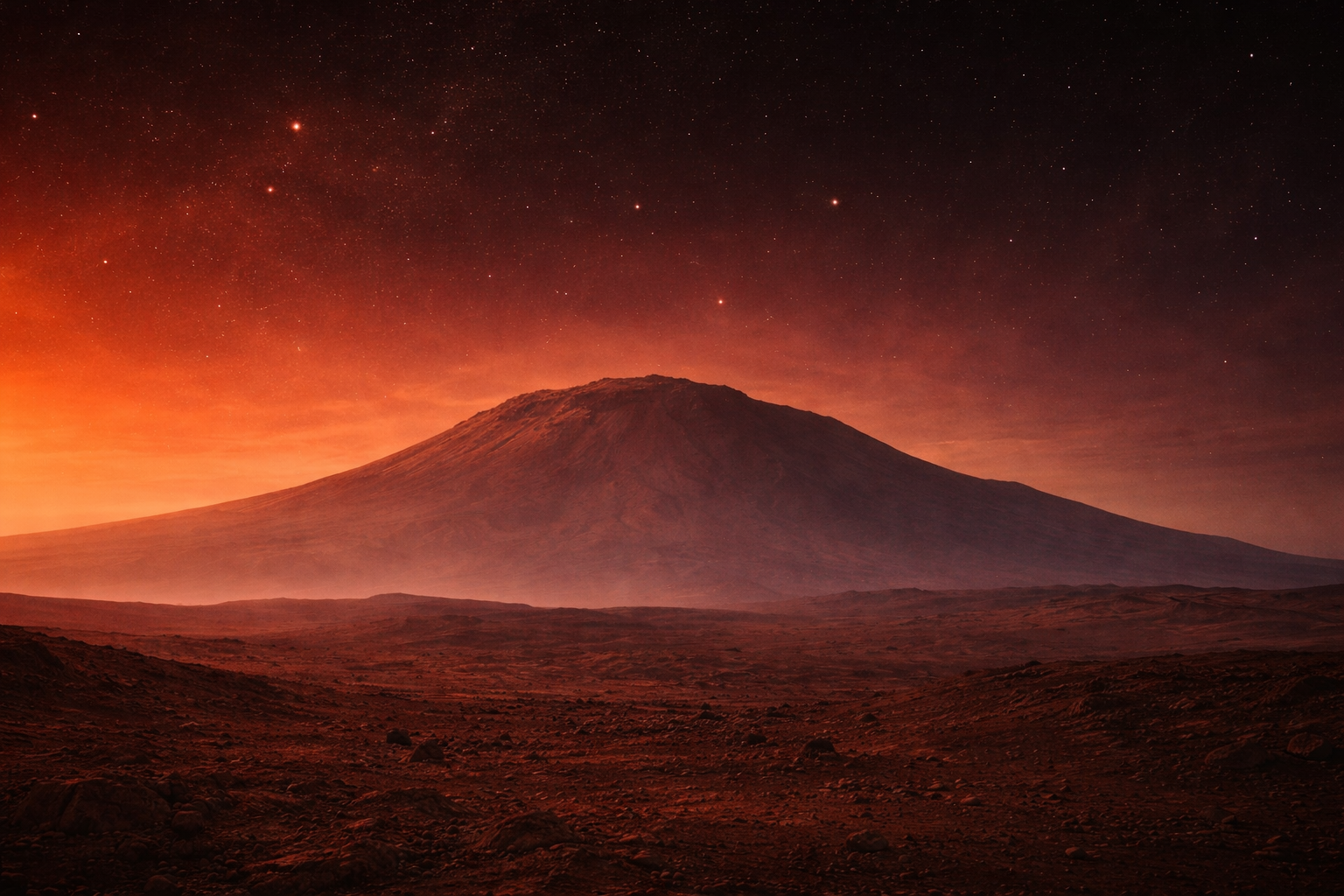
When we think of mountains, our minds usually travel to Earth’s great ranges — the Himalayas, the Andes, or the Alps. Peaks that challenge climbers, pierce the clouds, and define the limits of human endurance. But beyond Earth, on the dusty surface of Mars, stands a mountain that completely rewrites our understanding of size, scale, and planetary power.
Its name is Olympus Mons, and it is not only the tallest mountain on Mars — it is the tallest mountain in the entire solar system.
A Mountain Beyond Earthly Comparison
Olympus Mons rises approximately 25 kilometers (15.5 miles) above the Martian surface. To put this into perspective, Mount Everest, the tallest mountain on Earth, stands at 8.8 kilometers (5.5 miles) above sea level. That means Olympus Mons is nearly three times taller than Everest.
Yet height alone does not fully capture its immensity.
The base of Olympus Mons stretches nearly 600 kilometers (370 miles) across — an area comparable to the size of entire countries. Unlike the sharp, jagged peaks we associate with mountains on Earth, Olympus Mons is a vast, gently sloping shield volcano. From the ground, it appears deceptively flat, its summit hidden by the curvature of the planet itself.
Standing on Olympus Mons, a human would not see a dramatic peak rising ahead. Instead, they would experience a slow, almost imperceptible ascent lasting days.
How Mars Built a Giant
The secret behind Olympus Mons lies in how Mars works — and how it differs from Earth.
Earth’s crust is broken into moving tectonic plates. Volcanoes form where magma rises, but as plates shift, the volcanoes are carried away from their magma sources. This movement limits how large any single volcano can grow.
Mars, however, has no active plate tectonics.
Its crust remained largely fixed for billions of years. This allowed magma to erupt repeatedly from the same location, piling layer upon layer of lava over immense spans of time. With Mars’ weaker gravity, lava could spread farther before cooling, creating the volcano’s enormous width and gentle slopes.
Olympus Mons is the result of patience on a planetary timescale — millions of years of uninterrupted volcanic growth.
The Colossal Summit Caldera
At the summit of Olympus Mons lies one of its most striking features: a massive volcanic caldera nearly 80 kilometers (50 miles) wide. This caldera is not a single crater, but a complex of overlapping collapse pits formed during multiple volcanic episodes.
Each time magma chambers beneath the surface emptied, the ground above collapsed inward, reshaping the summit. These scars remain visible today, offering a geological record of Mars’ violent and dynamic past.
Is Olympus Mons Truly Extinct?
For a long time, Mars was considered a geologically dead planet. However, evidence from satellite observations suggests that some lava flows on Olympus Mons may be only a few million years old — extremely recent in planetary terms.
While Olympus Mons is currently dormant, scientists do not consider it fully extinct. Deep beneath the surface, residual heat may still exist. If Mars were to awaken volcanically again, Olympus Mons could, in theory, erupt in the distant future.
Discovered from Orbit
Olympus Mons was revealed in stunning detail during the early era of Mars exploration. In the 1970s, NASA’s Mariner 9 spacecraft became the first to orbit another planet, mapping Mars and uncovering its vast volcanic landscapes.
What scientists saw forever changed planetary science. Olympus Mons was not just a volcano — it was a record-holder beyond anything previously imagined.
A Reminder of Cosmic Scale
Olympus Mons teaches us a powerful lesson: the universe does not build according to human expectations.
On Earth, gravity, plate tectonics, and erosion impose limits. On Mars, those limits were different — and the result was a mountain so immense that it challenges intuition itself.
More than a geological wonder, Olympus Mons is a symbol of how diverse and astonishing planetary processes can be across the solar system.
Somewhere on the Red Planet, this silent giant still stands — vast, untouched, and unmatched — reminding us that nature, given enough time, knows no bounds.
Chaosmos News
Exploring the universe, one impossible story at a time. ?